Case study · E-commerce
Behaviour-based product recommendations for an online retailer
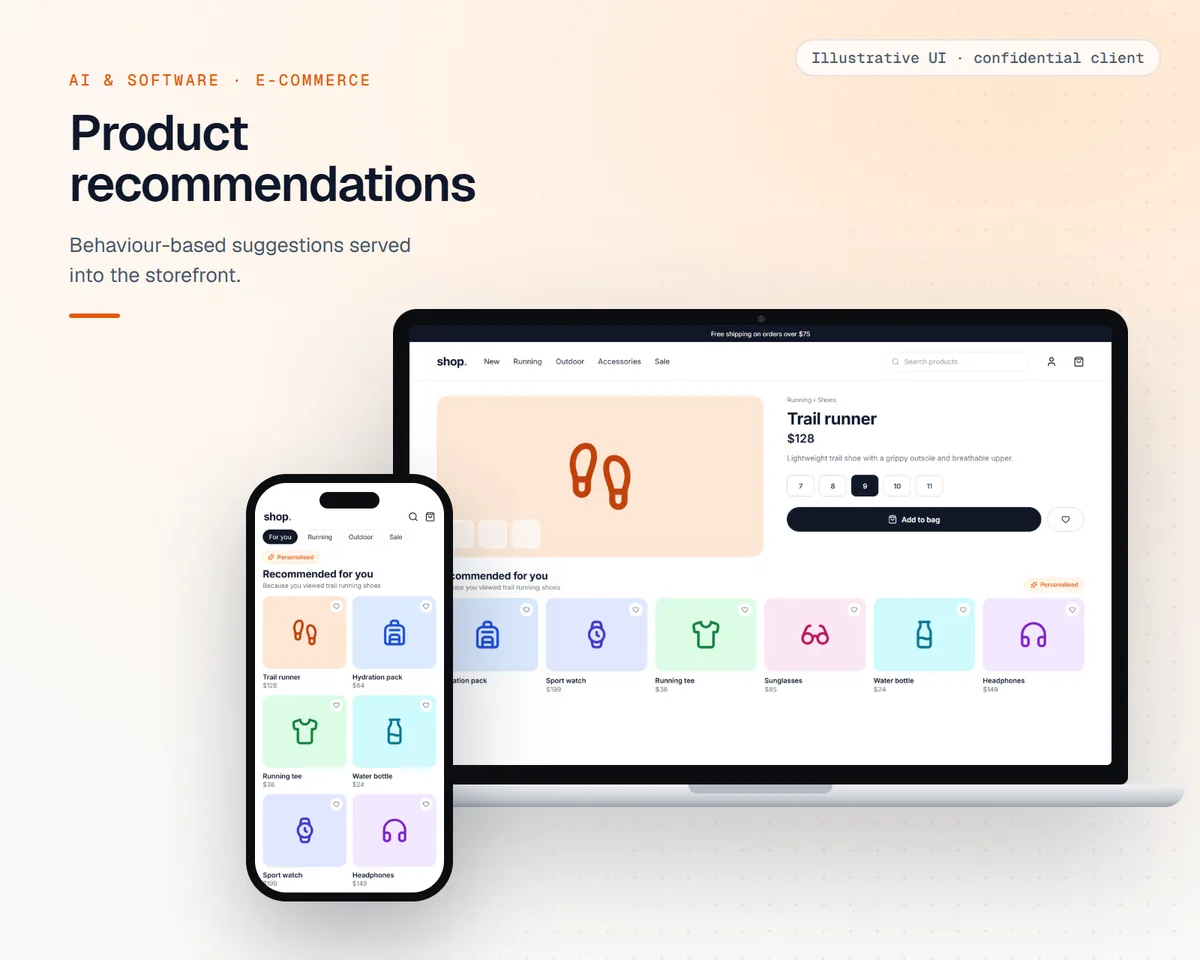
A recommendation engine that uses browsing and purchase behaviour to suggest relevant products, served through an API into the retailer's storefront.
- Client
- Confidential Client
- Industry
- E-commerce
- Year
- 2024
- Services
- Custom AI, Web Development
Business challenge
The problem
The retailer showed the same generic product suggestions to every visitor. They wanted recommendations that reflected what each shopper was actually browsing and buying.
Existing workflow
- Static 'related products' lists maintained by hand
- No use of behavioural data in the storefront
Solution
What we built
We built a recommendation pipeline that processes behavioural events — product views, cart additions, and purchases — and trains a deep-learning model to rank candidate products for each shopper.
Recommendations are served through an API that the storefront calls when rendering product and cart pages, with fallbacks to popular items when there is not enough behavioural signal.
Architecture
System overview
- 1
Events
Views, carts, and purchases collected.
- 2
Features
Behaviour and product attributes.
- 3
Model
PyTorch ranking model.
- 4
API
Recommendations served to the store.
- 5Human
Merchandising
Team controls exclusions and rules.
Product experience
- Personalised suggestions on product and cart pages
- Fallback recommendations for new visitors
- Merchandiser controls to exclude products or categories
Outcome
- Personalised recommendations live in the storefront
- A reusable recommendation API for future channels such as email
- Client-approved performance figures are not published
Integrations
- Storefront via REST API
- Supabase for event storage
Technology
- Next.js
- Python
- PyTorch
- Supabase
Lessons learned
What we took away
01
Cold-start fallbacks matter as much as the model for real shoppers.
02
Merchandising controls are essential — teams need to override algorithms for business reasons.
More work
Other case studies
Healthcare · 2024
Ilaaj AI — an AI-assisted health web app designed for low-resource settings
A browser-based healthcare application combining AI-assisted image screening, a symptom-intake assistant, and voice guidance, designed for clinics with limited specialist access and users with varying literacy.
Healthcare · 2024 · Confidential client
A clinic operations platform with AI-assisted administration
A full-stack web platform for a clinic to manage patient records, appointments, and administrative workflows, with AI used to prepare documentation for staff review.
Next step
Have a similar problem?
Tell us about the workflow, the systems involved, and what you want to change. We'll tell you honestly what a first build could look like.
What happens next
- 1Tell us about one workflow
- 2We review it before replying
- 3A working session, then a first-build proposal